Home » Clay Plaster: The Natural Material That Combines Well-Being, Aesthetics and Contemporary Architecture
CLAY Classe1935®: clay according to our vision, an ancient material reinterpreted in a contemporary key.
Even before being a building material, clay is one of the oldest materials with which man has built, protected and decorated his spaces.
Today, this primordial material is once again taking center stage in a new vision of living: more conscious, more natural, and more attentive to the well-being of the environment.
Clay-based decorative plasters represent an advanced choice for those seeking surfaces that combine aesthetics, living comfort, and respect for the material. This solution is appreciated by designers, architects, and green building enthusiasts for its ability to create balanced, healthy, and visually unique environments.
The CLAY Classe1935® line was born from this very philosophy: reinterpreting an ancestral material through contemporary research into decorative surfaces.
In the language of contemporary architecture, the wall is no longer considered simply a support to be decorated, but a surface capable of defining the identity of the space.
A natural clay-based finish transcends the traditional concept of aesthetic coating and becomes an integral part of the project: it interacts with the light, the materials present in the space, and the overall perception of the living space.
The material is not simply applied, but interpreted through texture, depth and tactile sensations that make each surface unique.
Clay plaster is a natural coating composed mainly of raw clay, selected sands and, in some formulations, plant fibres such as straw or hemp.
Unlike traditional coverings, it is not just an aesthetic finish, but a living surface that interacts with the surrounding environment.
Its composition allows you to create walls characterized by soft textures, natural shades and an authentic tactile perception, transforming any space into a warmer and more harmonious environment.
In natural construction, it is mainly used for interior surfaces, wooden houses, rammed earth buildings, restoration projects, and bio-architecture interventions where the breathability of the materials is a fundamental element.
A contemporary decorative surface works not only on chromatic tones, but on the relationship between material and perception.
The difference lies in the ability to create visual depth, natural variations, plays of light and an authentic tactile sensation.
Each application thus becomes a different experience, influenced by the applicator’s skill, the ambient light, and the identity of the space that hosts it.
The strength of clay lies in its simplicity.
It is a naturally occurring material, processed using low-energy processes and completely recyclable.
Clay plaster helps create healthier indoor environments thanks to its natural ability to absorb and gradually release moisture.
This characteristic makes clay surfaces particularly interesting in environments dedicated to daily well-being: private homes, bedrooms, living rooms, reception areas and environments where air quality plays a central role.
The return of clay to the world of architecture stems from a new awareness: contemporary spaces are designed not only through shapes and colors, but through the quality of the surfaces that compose them.
Natural materials such as clay, lime, earth, and mineral components today represent a new form of design expression, where artisan tradition and contemporary research meet.
The material is not hidden or imitated, but enhanced in its authenticity, creating surfaces capable of conveying balance, character, and depth.
Clay has a natural hygroscopic capacity: it absorbs excess moisture when present in the environment and gradually releases it when the air becomes drier.
This process helps improve living comfort and helps limit phenomena related to excessive condensation.
Clay-based finishes are free of harmful emissions and fit perfectly into projects geared towards quality living.
The mineral surface favors more natural environments, where authentic and breathable materials replace more synthetic solutions.
Thanks to its mass and physical characteristics, clay helps stabilize internal temperature variations.
The ability to accumulate and slowly release heat improves the perception of comfort throughout the different seasons.
Each clay surface has its own identity.
The textured textures, earthy tones, and chromatic possibilities offered by natural pigments allow you to create contemporary, minimalist, or more traditional environments.
The surface is not simply colored: it is designed.
Light becomes an integral part of matter.
A clay surface changes perception throughout the day, showing variations in tone, depth and texture in relation to the surrounding environment.
For this reason, a natural finish is not just an aesthetic choice, but a design element that contributes to creating the atmosphere of the space.
Like any natural material, clay plaster must also be used in the correct context.
Its main feature, the ability to interact with humidity, requires attention in environments subject to the constant presence of water.
It is not suitable for external surfaces directly exposed to atmospheric agents or areas where water can stagnate without adequate protection.
Compared to cementitious or synthetic plasters, it may require different application times and more careful installation, but these aspects are part of its artisanal nature and the pursuit of final quality.
Each material has specific characteristics.
Cement offers high mechanical performance and great resistance, but has a greater environmental impact linked to its production.
Plaster is practical, lightweight, and economical, ideal for dry environments, but less suitable where greater durability is required over time.
Lime represents an interesting balance between breathability, resistance, and construction tradition, and has always been a key player in restoration and green building.
Clay, on the other hand, stands out for its ability to create natural, breathable surfaces that are deeply rooted in the concept of living well-being.
The most frequent applications concern:
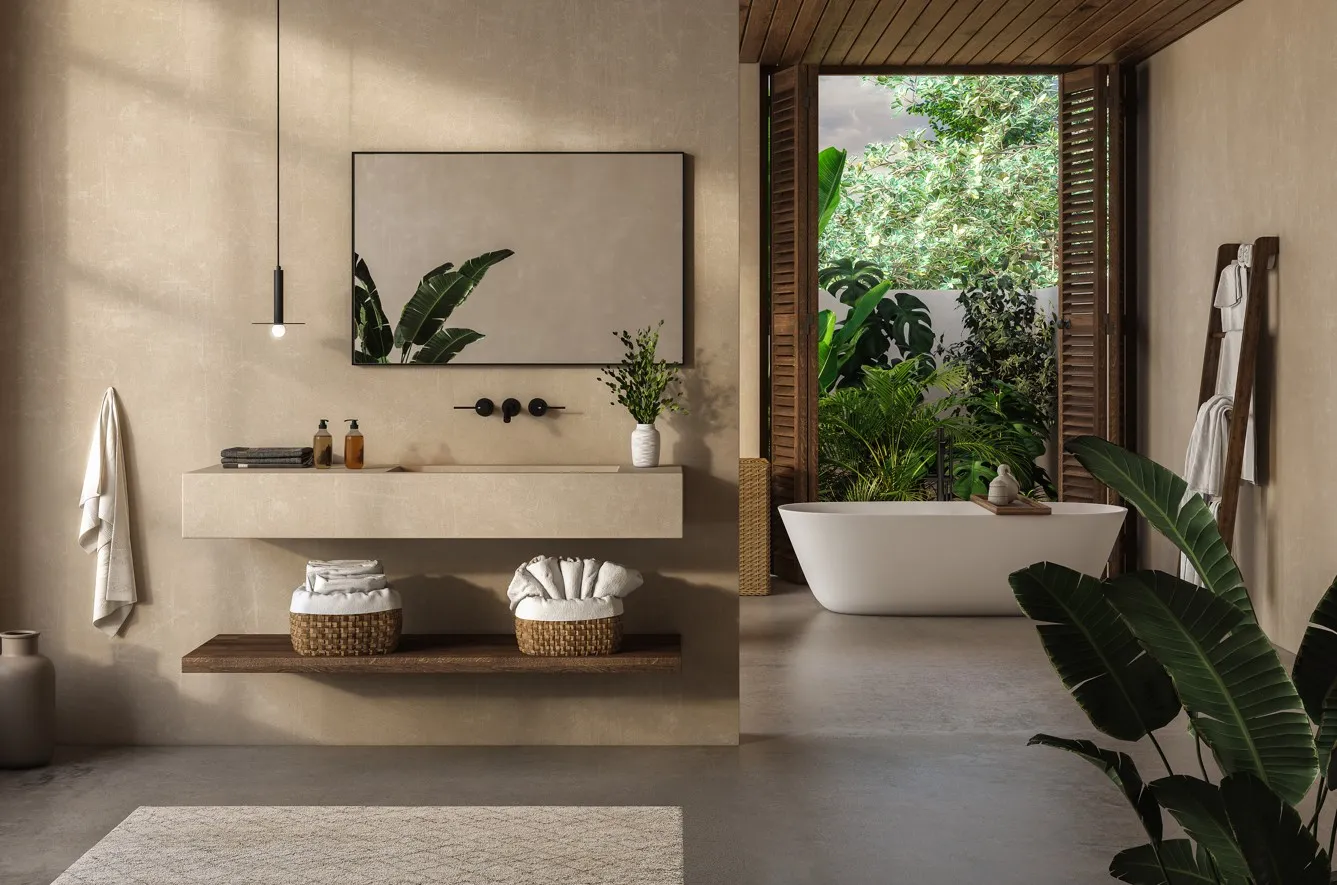
With compatible protective systems and finishes, it can also be used in environments such as kitchens and bathrooms, avoiding direct and permanent contact with water.
A high-quality decorative finish is born from the balance between material, support and application.
Surface preparation is a fundamental step in achieving a harmonious and long-lasting result: the substrate must be stable, adequately prepared, and consistent with the chosen application system.
In textured finishes, the applicator’s manual skill becomes part of the final result, because every gesture contributes to creating the uniqueness of the surface.
CLAY Classe1935® interprets clay not only as a natural material, but as a new design surface.
Through the textures, pigmentations and decorative components of the Gleam range, the material can be customized to create unique effects: from the simplicity of mineral surfaces to more sophisticated and scenic finishes.
Natural fibers, micas, mineral elements, decorative sands, and textured inserts expand the creative possibilities, transforming every wall into a unique surface.
Today, clay plaster represents the meeting point between memory and innovation.
A material used for millennia that, through research and design, finds a new identity in contemporary spaces.
CLAY Classe1935® is the natural surface that tells the story of the earth through the language of modern architecture.
Class of 1935
Decorative paint specialists with thirty years of experience. Passion, research, and constant innovation.