Home » Microcement: from its origins to the contemporary evolution of continuous surfaces
The role of the Tatanka System™ in modern architectural design according to Giuseppe Vitrani.
In the language of contemporary architecture, the concept of “cladding” is progressively disappearing.
Not because finishing materials are no longer needed, but because their role has evolved: from an accessory aesthetic element to a structural component of spatial perception .
Microcement fits into this scenario, one of the most representative solutions of the culture of continuous surfaces.
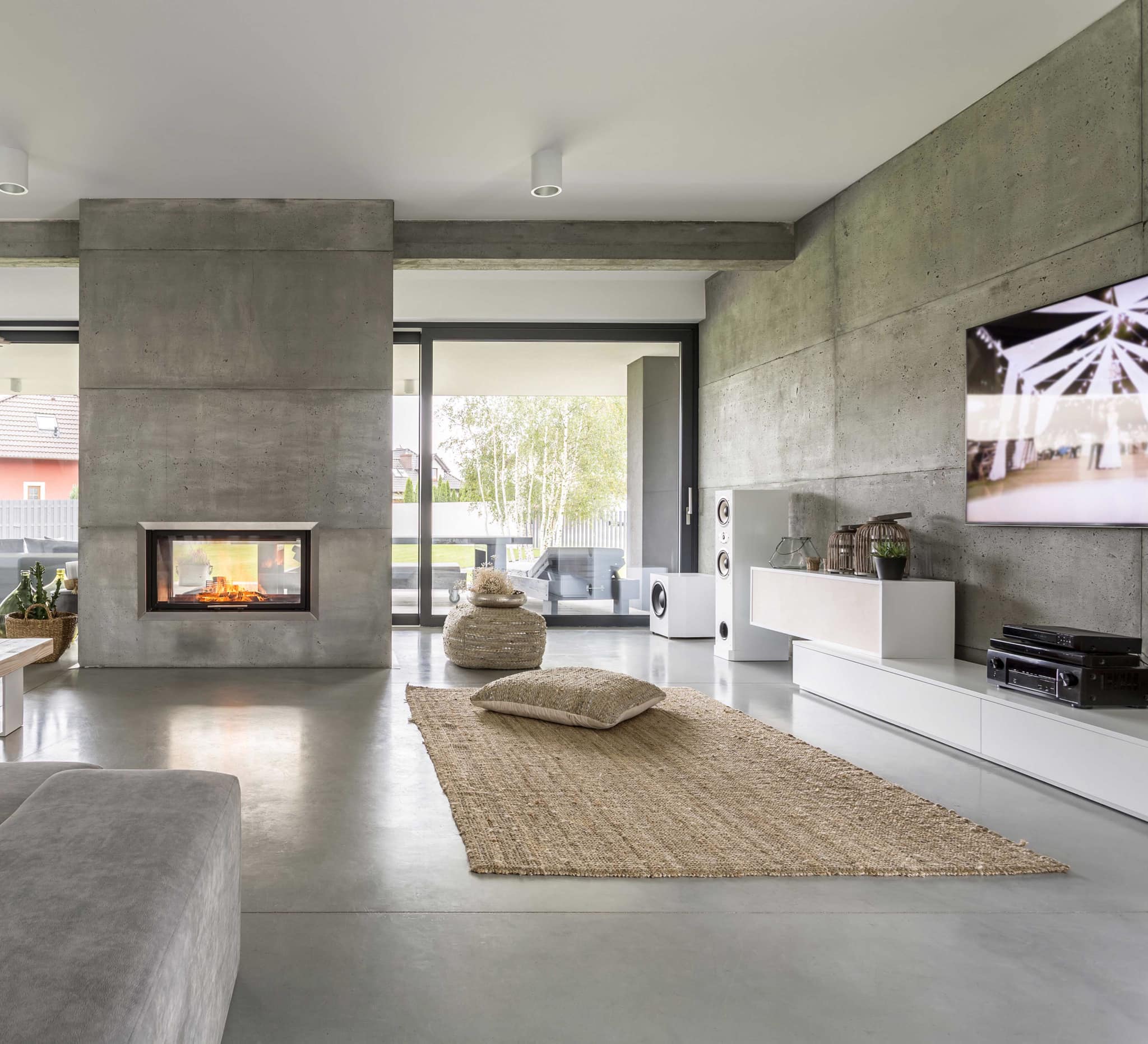
It is not simply a decorative material, but a system that eliminates the visual fragmentation typical of tiles, grouting and joints, transforming space into a material continuum.
Tatanka System™ Classe 1935® is part of this evolution, an advanced reinterpretation of microcement designed for contemporary high-performance architecture.
Microcement is a low-thickness mineral-polymer coating (generally 2-3 mm) composed of:
It is applied in multiple layers on existing surfaces, creating a continuous surface without joints.
The true value of microcement is not its composition, but the perceptual result:
a continuous surface, free of visual interruptions, capable of modifying the perception of space.
Modern microcement was not born as an isolated invention, but as the evolution of a long tradition of mineral-based materials.
Its roots can be traced back to three historical matrices:
Used in modern construction for decades, but limited by thickness and aesthetic rigidity.
Smooth concrete and hand-finished finishes used in industrial and rationalist architecture.
Which introduced controlled elasticity, adhesion on complex substrates and chemical resistance.
Contemporary microcement is therefore born as a hybridisation between mineral material and polymeric technology .
From a technical point of view, microcement is a layered system.
Determines hardness, compatibility with supports and structural inertia.
Regulates adhesion, flexibility and controlled elastic behavior.
Quartz and aggregates define abrasion resistance and surface texture.
The material exhibits the following behavior:
This allows continuous work on horizontal and vertical surfaces without loss of cohesion.
Microcement is now used in highly design-intensive architectural fields.
The main advantage is the redevelopment without demolition , thanks to the low thickness.
Many application failures are not due to the material, but to the system design.
The stability of microcement depends on the substrate rather than the finish.
Single-coat applications compromise durability and performance.
Unstabilized supports generate tensions and microcracks.
Without a resin cycle, the system remains incomplete.
In contemporary design, microcement is no longer a product, but an integrated surface system .
This evolution introduces a key concept:
we no longer design the finish, but the behavior of the surface over time.
This is where the advanced approach of new-generation professional systems comes in.
The Tatanka System™ Classe 1935® represents an advanced reinterpretation of contemporary microcement.
It is a high-performance continuous surface system designed to combine:
Tatanka is a single-component microcement composed of:
It mixes with water and is solvent-free.
Its pseudo-plastic and thixotropic nature allows:
With only 3 mm thickness , Tatanka allows:
Tatanka allows for advanced color design:
Color thus becomes part of the architectural project, not just a simple decorative finish.
In the contemporary surfaces sector, value is no longer just technical.
Continuous surfaces generate:
An end customer no longer perceives just a covering, but a coherent environment.
Application experiences confirm a paradigm shift:
“Tatanka has radically changed the way we experience spaces. It’s not just a floor, it’s an immersive experience.”
This perception highlights a central aspect of contemporary design: the surface as an experience.
The evolution of microcement requires advanced technical skills.
This is why the Master Superfici Continue Classe1935® was created, a technical-practical training course dedicated to professionals in the sector.
During the course, techniques such as:
Microcement is no longer a simple finishing material.
It has become a design language that directly influences the perception of architectural space.
In this evolution, the Tatanka System™ Class 1935® represents an integrated approach that combines:
The surface is no longer what closes the space.
This is what defines him. Giuseppe Vitrani, Business Owner CLASSE1935®
Class of 1935
Decorative paint specialists with thirty years of experience. Passion, research, and constant innovation.